
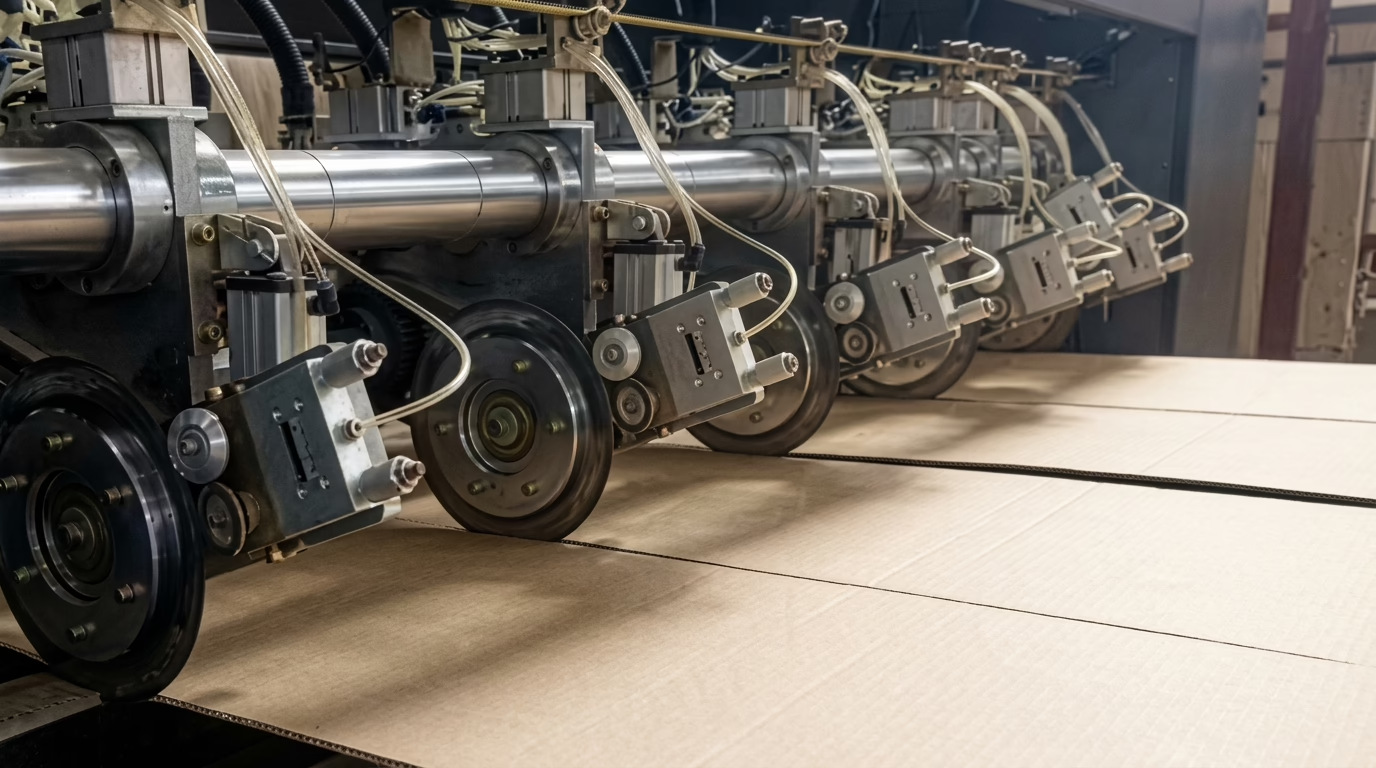
TiN Coated Tungsten Carbide Blades: An In-Depth Performance Analysis
If you work in industrial converting, slitting, or precision cutting, blade wear is a constant challenge. Abrasive materials, high line speeds, and continuous operation demand a cutting edge that lasts. TiN coated tungsten carbide blades represent the current gold standard for these environments — combining the structural strength of carbide with the surface hardness of titanium nitride. This article offers a detailed performance analysis to help engineers and procurement managers make an informed selection decision.
What Are TiN Coated Tungsten Carbide Blades?
TiN coated tungsten carbide blades are industrial cutting tools built on a tungsten carbide (WC-Co) substrate and finished with a Titanium Nitride (TiN) coating applied via Physical Vapor Deposition (PVD). The result is a blade that combines two distinct performance layers:
- The carbide substrate provides structural rigidity, fracture toughness, and dimensional stability under mechanical load.
- The TiN surface layer adds extreme surface hardness, reduces friction, and acts as a protective barrier against abrasive wear.
Together, these two layers in TiN coated tungsten carbide blades address the most common failure modes in industrial cutting: edge rounding, micro-chipping, and thermal degradation.
Material Specifications: Understanding What’s Inside
The Tungsten Carbide Substrate
The substrate in a high-performance cutting blade is typically composed of approximately 88% tungsten carbide (WC) and 12% cobalt (Co). This ratio is engineered to balance hardness and toughness — two properties that are often in direct opposition.
Key properties of the carbide substrate include:
- Hardness: HRA 90–92
- Density: ~14.5 g/cm³
- Grain size: Fine to sub-micron
The fine-grain microstructure is particularly important. Finer grains translate directly into sharper, more stable cutting edges, improved resistance to micro-chipping, and superior performance at high cutting speeds. This is why fine-grain carbide is the preferred substrate for precision slitting applications.
The Titanium Nitride (TiN) Coating
The TiN coating is applied using a PVD process — a vacuum-based deposition method that produces a highly uniform, well-adhered coating with excellent mechanical properties. The coating layer measures between 2 and 5 micrometres in thickness, thin enough to preserve edge geometry while adding significant surface protection.
Coating performance data:
- Hardness: 2200–2500 HV (Vickers)
- Coefficient of friction: 0.4–0.6
- Oxidation resistance: Up to 600°C
The gold-coloured TiN layer functions as a hard barrier that resists abrasive wear from filler particles, fibres, and abrasive coatings present in many industrial materials.
Edge Geometry and Finishing Options
Even the best material combination delivers limited results without proper edge geometry.
TiN coated tungsten carbide blades are available with several edge configurations:
- Double bevel (symmetrical): The standard configuration for most slitting applications
- Single bevel: Used for application-specific cutting requirements
- Micro-polished edge (MP): Reduces cutting force and improves cut surface quality
Advanced finishing allows an edge radius of below 1 micrometre, which results in lower cutting force, reduced material deformation, and consistently cleaner slit edges — particularly important when processing technical films, laminates, or nonwoven textiles.
Performance Characteristics: How Do TiN Coated Tungsten Carbide Blades Perform?
Abrasion Resistance
This is where TiN coated tungsten carbide blades deliver the most measurable advantage.
Compared to uncoated alternatives:
- 2–4× longer blade life versus uncoated tungsten carbide
- 5–10× longer blade life versus hardened steel blades
The mechanism behind this is straightforward: the TiN surface layer resists abrasion from filler particles embedded in the material being cut, while the carbide substrate prevents structural deformation of the blade body. The combination extends the interval between blade changes significantly.
Wear Mechanisms — and How They Are Addressed in TiN coated Tungsten Carbide blades
| Wear Type | How TiN Carbide Blades Address It |
|---|---|
| Abrasive wear | TiN surface hardness resists particle abrasion |
| Edge rounding | Carbide rigidity maintains edge geometry under load |
| Micro-chipping | Fine grain carbide provides toughness at the edge |
| Thermal degradation | TiN oxidation resistance up to 600°C |
Thermal Performance
Friction generates heat, and heat accelerates wear. The reduced coefficient of friction of TiN (0.4–0.6) means less heat is generated at the cutting interface. This is especially significant in high-speed slitting operations, where contact between blade and material is continuous and rapid. The result is more stable cutting performance over longer production runs without the thermal degradation that causes premature wear in uncoated blades.
Application Areas: Where TiN Coated Tungsten Carbide Blades Excel
TiN coated tungsten carbide blades are the preferred choice for cutting abrasive and filler-loaded materials.
Typical applications include:
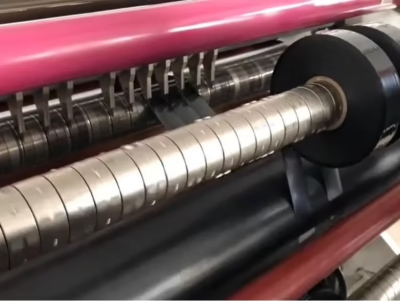 High abrasive load:
- Gasket materials (fibre-reinforced, composite)
- Glass-filled plastics such as reinforced nylon
- Laminates and multilayer films
Moderate abrasive load:
- Mineral-filled paper and cardboard
- Corrugated board
- Nonwoven technical textiles
Additional materials:
- Rubber with fillers
- Fibre-reinforced sheets
- Abrasive-coated substrates
TiN coated Tungsten Carbide blades are compatible with a range of cutting methods including razor slitting, shear slitting, oscillating knife cutting, and are suited to slitting and converting lines, flatbed cutting tables, and rotary slitting systems.
TiN vs Alternative Coatings: A Direct Comparison
Not every coating suits every application. Understanding the trade-offs between TiN, DLC (Diamond-Like Carbon), and PTFE coatings helps in making the right selection.
| Performance Parameter | TiN | DLC | PTFE |
|---|---|---|---|
| Abrasion resistance | Excellent | Very good | Limited |
| Edge life on abrasive materials | Excellent | Very good | Limited |
| Adhesion resistance | Moderate | Excellent | Excellent |
| Friction reduction | Good | Excellent | Excellent |
The engineering conclusion is clear: TiN is the optimal coating for abrasive cutting environments. Where the primary challenge is adhesive build-up rather than abrasive wear — for example, when cutting adhesive films or sticky laminates — DLC or PTFE coatings are the better choice.
Operational and Cost Benefits of TiN coated Tungsten Carbide blades
The performance gains of TiN coated tungsten carbide blades translate directly into measurable operational and financial advantages:
Productivity:
- Fewer blade changes per shift
- Higher machine uptime
- More consistent cutting performance across long production runs
Cut quality:
- Cleaner slit edges with reduced fraying or tearing
- More consistent slit width throughout blade life
- Lower rates of material scrap
Total Cost of Ownership (TCO) of TiN coated Tungsten Carbide blades:
Although TiN coated carbide blades carry a higher unit price than steel or uncoated carbide blades, the extended blade life, reduced maintenance intervals, and lower scrap rates typically result in a significantly lower cost per metre of material processed.
Selection Guide: When to Specify TiN Coated Tungsten Carbide
Choose TiN coated tungsten carbide blades when:
- The material contains abrasive fillers, fibres, or coatings
- Cutting speed is high and thermal stability is required
- Abrasive wear is the primary blade failure mode
- Process stability and consistent output quality are critical
Avoid TiN coating when the primary issue is adhesive build-up on the blade. In that case, specify DLC or PTFE coated blades instead.
Conclusion
For industrial cutting operations involving abrasive, filler-loaded, or high-wear materials, TiN coated tungsten carbide blades represent the optimal balance between hardness, durability, and cost efficiency. The combination of a fine-grain carbide substrate with a PVD-applied titanium nitride coating addresses every major wear mechanism in demanding slitting and converting environments — delivering longer blade life, cleaner cuts, and lower total operating costs.
If you are evaluating blade upgrades for your converting line or would like to discuss the right blade specification for your application, or browse our range of .


